



Why HVAC Customers Cancel Memberships (And the One System That Stops It)
Companies with active service agreement programs retain 60 to 80 percent of customers year over year. Companies without them retain somewhere between...
4 min read
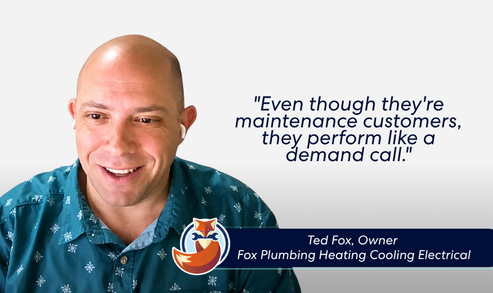
For 27 years, Fox Plumbing Heating Cooling Electrical has been a family-owned home-services company serving Vernon, British Columbia.
Like most established contractors, Fox has always looked for productive ways to keep technicians busy during slower periods. Traditional approaches included contacting customers who were due for maintenance, reconnecting with homeowners who had not been serviced recently, and letting existing customers know about the company’s other services.
Those methods produced results, but the outreach was often based on timing rather than an identifiable change in the customer’s equipment.
That began to change when Fox started using HVAC performance information to identify participating customers whose systems were showing unusual operating conditions.
Instead of simply saying, “It may be time for maintenance,” Fox could contact a homeowner with a more useful message: “Your system is showing a change in performance that may be worth checking.”
That gave customers a clearer reason for the call and gave Fox’s technicians a better understanding of what to investigate when they arrived.
The shift was straightforward: Fox began prioritizing outreach based on system information rather than relying only on a calendar.
A flagged condition does not necessarily mean that a system requires a major repair. It could be related to airflow, a filter, temperature differential, system performance, or another issue that should be professionally assessed. The value lies in giving the homeowner an opportunity to investigate the condition before it potentially becomes a breakdown.
“We looked at it as an opportunity to let the customer know that something may be changing,” says Ted Fox. “We can go out, inspect the system, perform the maintenance that is needed, and explain anything else we find.”
This approach changed the conversation for everyone involved.
Dispatchers had a more relevant reason to contact the customer. Technicians arrived with useful background information. Most importantly, homeowners received a timely heads-up about their equipment rather than a generic sales message.
Fox did not rely on a single outreach strategy. The team tested different lists, messages, and communication methods to determine what produced the best customer response.
In one automated campaign, Fox contacted 128 customers. Fifteen responded, and nine of those customers booked paid work. The resulting jobs averaged approximately $800 per ticket.
In another campaign, the company contacted 167 customers. Approximately 73% responded, and about half of those respondents booked an appointment, representing more than 60 jobs from one outreach effort.
A smaller campaign contacted 57 customers. Approximately 35% responded, and about 90% of those respondents booked.
Results varied between campaigns, but the overall pattern was clear: customers were substantially more receptive when the outreach was connected to relevant information about their own HVAC system.
Fox also tested adding a live follow-up call to automated outreach. When an outbound call centre contacted customers from a list that had initially generated a 12% automated response rate, booking rates rose into the high-30% range.
“Having that human experience was definitely better than relying on a text message alone,” Ted says.
For contractors, this is an important part of the opportunity. Smart system information can identify where attention may be needed, but the contractor’s communication and customer service ultimately turn that information into a positive homeowner experience.
Fox typically sees a meaningful difference between scheduled maintenance visits and calls where a customer is already experiencing a concern:
Visits prompted by system performance information have often behaved more like demand-service calls than routine maintenance appointments.
The reason is not simply that technicians have a better sales opportunity. It is that the visit begins with greater relevance. The homeowner understands why Fox is recommending an inspection, and the technician has a specific condition to assess.
This creates an opportunity to identify routine maintenance needs, correct smaller concerns, discuss repair options when appropriate, and help the customer make an informed decision about the system.
Since launching the program, Fox estimates that this type of outreach has contributed to hundreds of booked jobs. The company is now working toward more formal campaign tracking so it can measure results with even greater precision.
“Even though many of these are maintenance customers, the calls can perform more like demand calls because there is an actual reason for the visit,” Ted explains. “Customers are more prepared to listen to the findings and consider their options.”
Technology only creates value when the people using it understand what the information means.
Fox’s rollout included an adjustment period. Some technicians initially assumed that a flagged condition would usually lead to something simple, such as replacing a filter.
The company coached the team to treat the information as a starting point rather than a diagnosis. A pressure or temperature change might have a simple explanation, but it could also indicate a developing performance issue. The technician’s role is to inspect the complete system, determine what is happening, and clearly explain the findings to the homeowner.
“We started talking with the team about doing a complete inspection while we’re there,” Ted says. “The information gives us a reason to look more closely, but the technician still needs to assess the system properly.”
That distinction is important for maintaining customer trust. The system identifies a condition worth investigating; the trained technician determines whether any action is needed.
Ted points to consistency and transparency as two reasons the program has become a valuable part of Fox’s operation.
The customer list updates automatically, reducing the time employees spend searching for people to contact. Participating customers can also see information about their own systems, helping them understand why Fox is reaching out.
That transparency makes the communication feel less like a promotion and more like a useful service notification.
“It’s a very honest list,” Ted says. “We’re reaching out for a reason, and the customer can see that information as well. When we’re looking for opportunities to help customers and keep calls on the board, it’s a great place to start.”
Fox’s experience demonstrates how monitored HVAC information can create value on both sides of the service relationship.
Homeowners benefit from:
Contractors benefit from:
The technology surfaces the information, but the contractor determines how that information is used. Fox’s results came from combining system insights with thoughtful communication, professional inspections, and transparent recommendations.
For contractors looking to generate more service opportunities without relying entirely on new leads, existing customer-system data can be an exceptionally valuable resource.
SmartAC empowers HVAC service providers with smart monitoring, real-time analytics, and a seamless homeowner engagement experience designed to fuel long-term business growth. Book a demo or explore the platform to see what it can do for your business.

Companies with active service agreement programs retain 60 to 80 percent of customers year over year. Companies without them retain somewhere between...
A technician spends twenty minutes taking measurements, checking static pressure, and confirming that a system is operating well below its intended...
Every spring and summer, HVAC contractors shift into execution mode. Trucks roll, phones ring, technicians run wall‑to‑wall calls. The board fills up...